
Anyone who deals with regular muscle or joint discomfort has probably noticed a shift in how over-the-counter relief is packaged. Alongside the usual jars of cream and bottles of gel, a pain relief roll on now sits on more pharmacy shelves and more bathroom counters than it did a few years ago.
The appeal is simple: no fingers dipped into a tub, no residue left on furniture or clothing, and a shape that’s easy to toss into a gym bag or glovebox. This article looks at what a pain relief roll on actually is, the ingredients typically behind the format, and the practical questions worth asking before buying one.
What Is a Pain Relief Roll On?
A pain relief roll on is a topical analgesic built around a rollerball applicator instead of a cap, brush, or open jar. Twisting the bottle raises the ball, and rolling it across skin spreads the formula in a thin, even layer without ever touching the liquid directly. That single design choice is what separates a roll on pain reliever from a standard cream: hands stay clean, and there’s no need to wash up before touching a phone, a steering wheel, or a child moments later.
Most formulas in this category rely on camphor, menthol, and peppermint oil — a combination long used in topical pain relief products for the cooling and warming sensations they produce on the skin. Some newer formulas also add small amounts of arnica, turmeric, or ginger oil, though the core mechanism across brands is largely the same: a topical pain relief roll on works by distracting nerve endings from the underlying ache rather than treating its root cause.
Features and Benefits
Mess-Free, Precise Application
Because the roller controls exactly where the liquid goes, a pain relief roller stays contained to the spot that needs it, unlike a spray that can drift or a cream that ends up under fingernails. This makes a muscle pain relief roll on easier to use on a shoulder or calf right before or after exercise, and plenty of people keep a pain relief roller for sore muscles right in their gym bag for that reason. It’s also part of why a portable pain relief option like this tends to get used more consistently than a jar left at home.
Reaches Places Fingers Can’t
A longer bottle with a rollerball on the end can reach the middle of the back without help from anyone else — a detail that matters more than it sounds for a back pain relief roll on. Sitting at a desk all day or sleeping in an awkward position tends to load up exactly that hard-to-reach area.
A Cooling, Then Warming Sensation
The menthol content is largely responsible for the sensation most people associate with a cooling pain relief roll on: a brief chill that gradually gives way to gentle warmth as camphor takes over. That combination is often described as a soothing pain relief roll on effect, since neither sensation is sharp or unpleasant on unbroken skin.
Works Across Common Trouble Spots
The same basic formula in most bottles is marketed for the same list of everyday complaints: a pain relief roll on for back pain, a pain relief roll on for neck pain, a pain relief roll on for joint pain, and a pain relief roll on for muscle pain. Whether it holds up as a joint pain relief roll on for an arthritic knee or a muscle pain relief roll on for a strained calf tends to come down to consistent, correct use rather than any difference in the underlying ingredients.
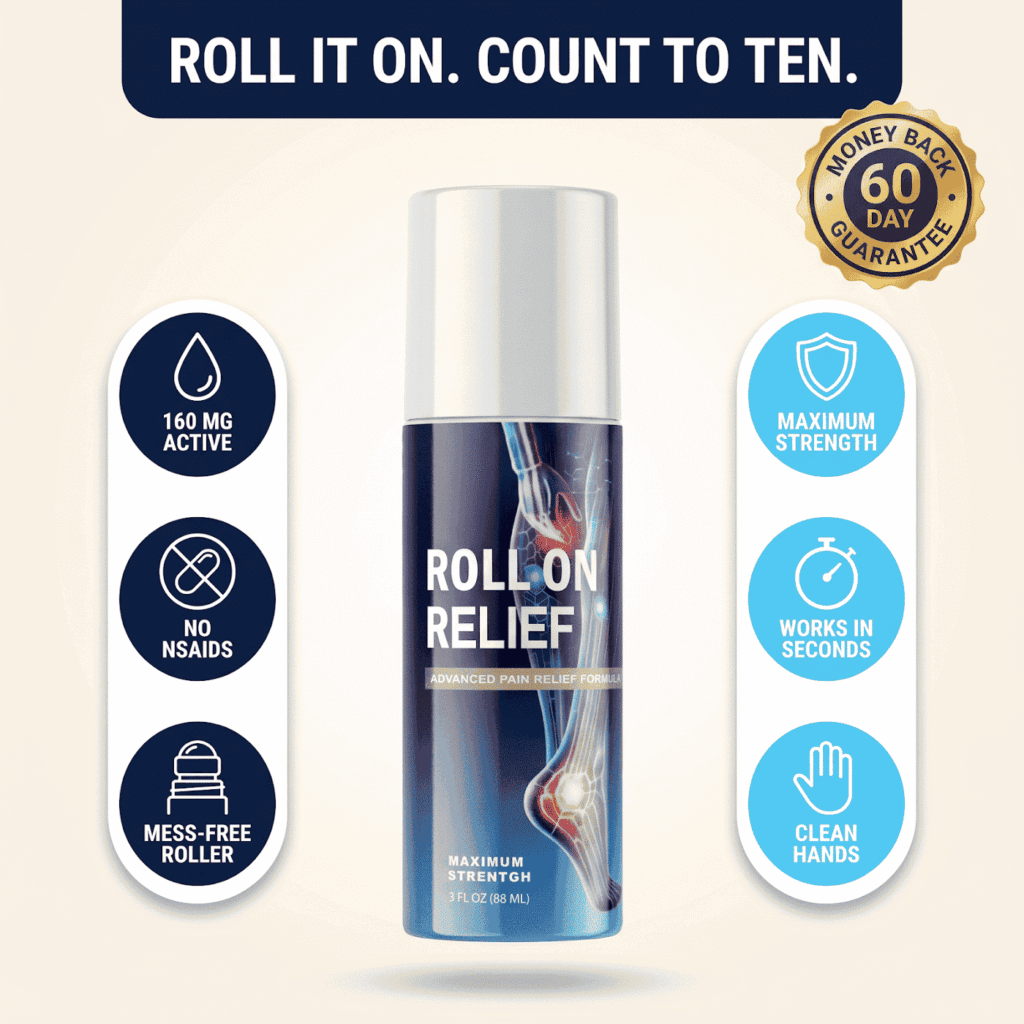
Important Things to Know Before Using One
Like any topical pain relief roll on, these products are meant for external use only and should be kept away from the eyes, mucous membranes, and broken or irritated skin. Most labels also warn against combining the roll-on with a heating pad, since the two together can raise the risk of skin irritation. Hands should still be washed with cool water after each use, even though the roller keeps fingers off the liquid during application, since a small amount can transfer during the rolling motion itself.
Labels in this category typically limit use to adults and children over twelve, with a maximum of four applications a day. Anyone whose pain lasts longer than seven days, or who is pregnant or breastfeeding, is generally advised to check with a doctor before continuing. Pain that is severe or getting worse deserves a proper medical evaluation rather than more roll-on.
Roll-On vs. Cream vs. Spray vs. Gel
| Format | Mess Level | Precision | Portability | Best For |
|---|---|---|---|---|
| Roll-on | Low — no direct hand contact | High — ball controls placement | High — compact, unlikely to leak | Reaching the back, on-the-go use |
| Cream | Higher — rubbed in by hand | Medium | Medium — jars can be bulky | Larger areas, slower massage-in application |
| Spray | Low, but can drift | Low — hard to target precisely | High | Quick, hands-free application |
| Gel | Medium | Medium-high | Medium | A cooling sensation on contact |
For anyone comparing a pain relief gel roll on against a plain roll-on or a jar of cream, the trade-off usually comes down to spreadability versus mess. A gel-based roll-on tends to feel lighter on the skin, while a thicker cream spreads over larger areas more evenly by hand.
Pros and Cons
Pros
- No mess and no residue left on the hands
- Reaches awkward spots like the middle of the back
- Ingredient amounts are often printed clearly, unlike vague “extra strength” labeling
- Compact enough for a gym bag, desk drawer, or nightstand
- Nothing swallowed, so it doesn’t interact with anything taken by mouth
Cons
- The cooling and warming sensation isn’t for everyone; strong menthol can feel intense on sensitive skin
- Not meant for broken, irritated, or sunburned skin
- Provides temporary relief only, not a fix for the underlying cause of chronic pain
- A rollerball applicator can occasionally leak if the bottle is dropped or cracked
How to Choose One / Who It’s For
A roll on for sore muscles suits anyone who exercises regularly and wants something quick to use before or after a workout. A roll on for muscle aches from everyday tension — a long commute, hours at a desk, or a bad night’s sleep — is generally interchangeable with the same formula. For older adults managing arthritis, a roll on for arthritis pain that goes on without needing much grip strength tends to be easier to manage day to day than a jar with a tight lid. Athletes recovering from a hard training session might specifically look for a roll on for sports pain that can be reapplied quickly between sets or after a game. For stiff knees, hips, or knuckles, many people simply look for pain relief for sore joints rather than a muscle-specific formula, and use the same bottle for general joint pain relief across whichever joint is acting up that week.
A few checks are worth doing before buying:
- Ingredient list — whether milligram amounts are printed for each active ingredient, not just a vague “maximum strength” label
- Drug Facts box — a sign the product follows standard over-the-counter labeling
- Return policy — a longer guarantee window suggests the seller expects most buyers to be satisfied
- Reviews mentioning skin sensitivity, since menthol-heavy formulas vary in intensity between brands
Frequently Asked Questions
Does a pain relief roll on actually work?
It can help with temporary discomfort from minor muscle and joint aches, arthritis, backache, strains, or sprains, largely through the cooling and warming sensation of ingredients like menthol and camphor. It’s not a cure and won’t resolve the underlying cause of ongoing pain.
Is there a natural pain relief roll on option?
Some brands market themselves as a natural pain relief roll on by leaning on plant-based ingredients such as arnica, turmeric, and essential oils alongside camphor and menthol, rather than relying on synthetic additives alone. The label’s ingredient list is the clearest way to check.
How fast does it work?
Most labels don’t promise a specific timeframe, since results vary by person, but many people describe a fast acting pain relief roll on as one where the cooling sensation from menthol is noticeable within a minute or two of application. That sensory response is separate from whether the underlying ache actually improves.
Can it be used for neck pain?
Yes. A neck pain relief roll on is applied the same way as a back or shoulder version, in a thin layer over the affected muscles, up to the labeled number of times per day. Neck pain relief in general responds well to the same approach used elsewhere on the body, though care should be taken to avoid the eyes when applying it that close to the head.
How does it compare to a cream for back pain?
Both a roll-on and a cream are generally allowed to make the same label claims, so back pain relief comes down to preference. People who dislike rubbing product into a sore lower back with their hands often prefer a back pain relief roll on simply because no direct hand contact is needed to spread it.
Is it safe for daily muscle soreness after workouts?
Generally yes, within the labeled limit of up to four applications a day. For muscle soreness relief after a workout, many people find a roll-on more convenient than a cream, since it can be reapplied later without washing hands first. Anyone looking for ongoing muscle ache relief, rather than just immediate post-workout use, should still watch for skin irritation with repeated daily use.
Final Thoughts
A pain relief roll on won’t replace medical treatment for a serious injury or chronic condition, but as an everyday option for muscle tightness, joint stiffness, or a sore back after a long day, the format has clear practical advantages over creams and sprays: clean hands, easy reach, and a size that travels well. Checking the ingredient list, the Drug Facts panel, and the return policy before buying is a reasonable way to compare one bottle against another, whatever the brand.
Visit the Official Roll On Relief Page 60-day money-back guaranteeThis article is for informational purposes only and is not a substitute for professional medical advice. Always talk to a doctor about a medical condition before starting or stopping any treatment. This post contains an affiliate link; a purchase made through it may earn a commission at no extra cost to you.